Building a Multimodal AI Decision Engine for Complex Logistics Networks
Optimizing freight across ocean, air, truckload, and rail simultaneously requires a fundamentally different architecture than single-mode route planning. Here is how multimodal AI decision engines work and why they deliver superior outcomes.
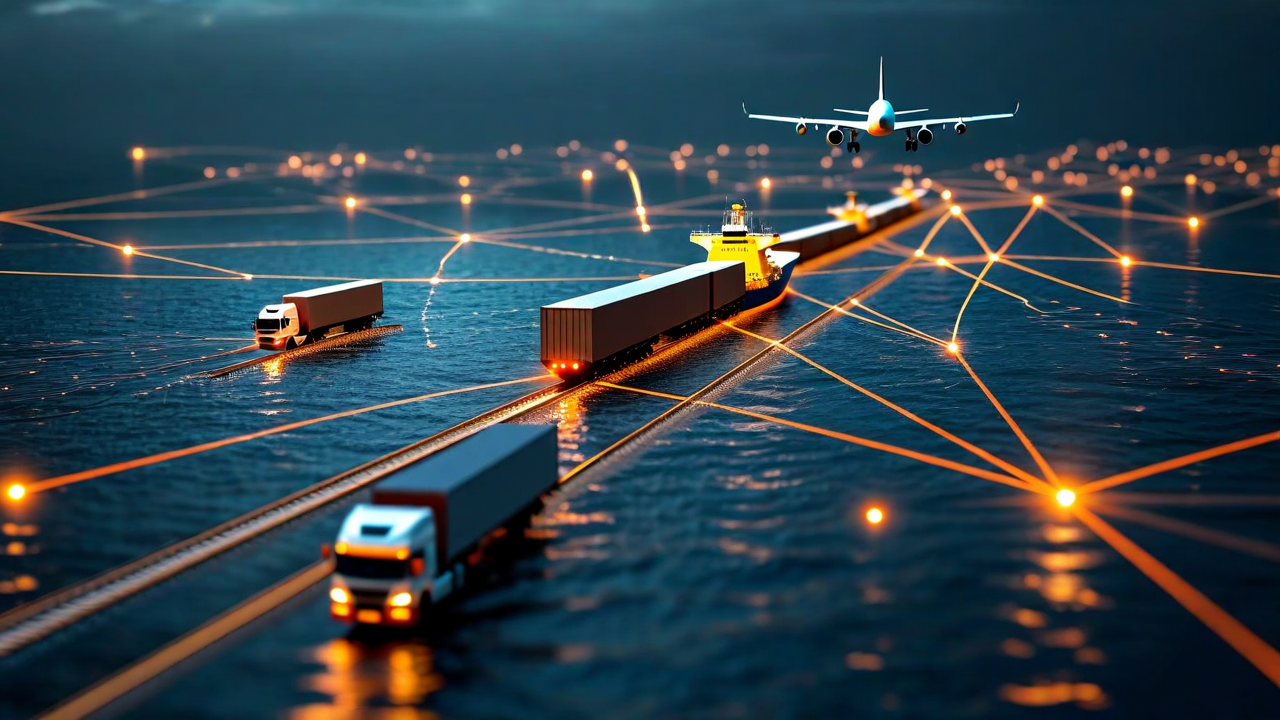
Modern supply chains rarely move goods via a single transport mode from origin to destination. A consumer electronics shipment from a contract manufacturer in Vietnam might involve local trucking to a port, ocean freight to Los Angeles, rail to Chicago, and regional truckload delivery to a distribution center. Each leg involves a different carrier, different rate structures, different reliability profiles, and different optimization variables.
Traditional logistics software handles this by treating each mode separately: ocean booking tools, domestic TMS systems, and air freight portals operate in isolation, and the integration between them falls to logistics coordinators who manually stitch the pieces together. The result is systematic underoptimization. The best individual-mode choices are rarely the best combined-mode choices, and the coordination overhead consumes significant operational bandwidth.
A multimodal AI decision engine takes a fundamentally different approach. Instead of optimizing each leg in isolation, it models the entire origin-to-destination journey as a single optimization problem and finds the combination of modes, carriers, routes, and handoff points that delivers the best outcome across the full journey. This is harder to build, but significantly more valuable to operate.
The Architecture of a Multimodal AI Decision Engine
At the core of any multimodal AI decision engine is a unified data model that represents freight options across all modes in a comparable format. This sounds obvious but is technically challenging, because ocean freight is priced and structured very differently from truckload, which is different from air, which is different from rail. Creating a normalized representation that enables apples-to-apples comparison across modes requires significant data engineering work before any ML modeling can begin.
Once data is normalized, the optimization layer applies machine learning to two distinct problems. The first is prediction: given a specific origin-destination pair, commodity type, weight, and required transit window, what are the expected cost, transit time, and reliability scores for each candidate mode-carrier combination? This is a regression problem that the system learns from historical shipment data, continuously updating its estimates as new shipments are completed.
The second problem is selection: given a set of candidate options with predicted performance characteristics and the shipper's current optimization preferences, which combination of legs should be recommended? This is a multi-criteria decision problem that requires balancing competing objectives — minimizing cost while meeting transit time requirements while maintaining acceptable reliability thresholds — in a way that reflects the shipper's actual priorities.
The handoff problem is the third critical component. In multimodal shipments, the connections between legs — transloading at port, dray from rail ramp to warehouse, transfer at air freight hub — introduce additional cost, time, and risk. A good multimodal AI engine models handoff options explicitly and incorporates them into the total journey optimization rather than treating them as fixed or ignoring them entirely.
Data Inputs That Drive Multimodal Intelligence
The quality of a multimodal AI decision engine is fundamentally constrained by the quality and breadth of its input data. Several data categories are particularly important for building accurate multimodal models.
Historical shipment records across all modes provide the foundational training data for both the prediction and selection models. The more historical data available — ideally with actual transit times, carrier-level performance, and total delivered cost including all accessorial charges — the more accurately the system can predict future performance. This is why data aggregation at scale is such a significant competitive advantage in logistics AI.
Real-time market rate data is essential for cost prediction accuracy. Ocean spot rates, domestic truckload and LTL rates, and air cargo rates all fluctuate significantly with market conditions. A model trained only on historical rates will produce systematically biased cost estimates in either direction depending on whether the market has moved up or down since the training period. Real-time rate feeds allow the model to calibrate its predictions to current market conditions.
Carrier performance data goes beyond transit time to include reliability (percentage of shipments arriving within the committed window), damage rate, tender acceptance rate, and EDI/tracking data quality. These dimensions of carrier performance significantly affect the true cost of using a given carrier on a given lane, but they are rarely captured systematically in legacy TMS systems. AI platforms that track and model carrier performance at this level of granularity produce meaningfully better recommendations.
External signal data — port congestion indices, weather forecasts, labor dispute monitoring, customs clearance performance data — rounds out the input picture. These signals allow the decision engine to anticipate disruptions before they affect active shipments and adjust routing recommendations proactively.
The Optimization Layer: Beyond Simple Cost Minimization
Real logistics decisions involve multiple objectives that must be balanced simultaneously. Cost minimization is almost never the only goal. Transit time constraints are often binding — a shipment must arrive by a specific date regardless of cost. Carrier relationship preferences may limit which alternatives are acceptable. Sustainability commitments may impose carbon emission constraints on routing decisions. Risk tolerance varies by shipment value and customer sensitivity.
A sophisticated multimodal AI decision engine does not just minimize cost subject to a transit time constraint. It models the full preference structure of the decision-maker and finds the Pareto-optimal set of routing options — the set of options where no single objective can be improved without degrading another. It then presents this set to the logistics team with clear tradeoff analysis, enabling informed decisions rather than automated ones that may miss important context the system cannot observe.
This design philosophy — AI as decision support rather than autonomous decision-maker — is important for enterprise adoption. Logistics teams are accountable for outcomes, and they need to be able to explain and defend routing decisions. A system that shows them the best options with supporting evidence earns their trust over time. A system that makes decisions opaquely does not, regardless of its technical accuracy.
The RouteBrain platform is built on exactly this philosophy. Our decision engine surfaces ranked routing recommendations with transparent explanations of why each option is recommended and what tradeoffs are involved, giving logistics teams the information they need to make fast, confident decisions.
Integration Requirements for Multimodal AI
A multimodal decision engine is only as useful as its ability to integrate with the systems that logistics teams actually use. In most enterprises, this means connecting to a TMS for shipment record management, an ERP for order and inventory data, a WMS for warehouse scheduling, and potentially multiple carrier portals or booking platforms for tendering. The integration layer of a multimodal AI platform is often underappreciated relative to the modeling layer, but it is equally critical for operational adoption.
Bidirectional integration is particularly important. The system needs to receive incoming shipment orders to trigger routing recommendations, but it also needs to push routing decisions back into the TMS for execution and receive shipment status updates for real-time visibility. One-directional integrations that require manual data entry at any point create friction that reduces adoption and introduces errors.
API-first architecture is the modern standard for this kind of integration. Well-designed REST APIs enable flexible connectivity to any TMS or ERP system, regardless of the underlying technology stack. EDI integration remains important for carrier connectivity, particularly with larger ocean and truckload carriers that have standardized on EDI for order management and status communication.
Measuring the Performance of a Multimodal AI Engine
Evaluating whether a multimodal AI decision engine is actually improving logistics outcomes requires measurement frameworks that go beyond simple cost comparison. Several metrics provide a comprehensive view of decision engine performance.
Recommendation acceptance rate measures how often logistics teams follow the system's recommendations rather than overriding them. High acceptance rates indicate that the system's recommendations are trustworthy and aligned with operational preferences. Low acceptance rates indicate a calibration problem — either the model is missing important constraints, or the interface is not presenting recommendations in a way that earns operator confidence.
Predicted versus actual performance measures how accurately the model's transit time and cost predictions match actual outcomes. Systematic prediction errors reveal model biases that can be corrected through retraining or feature engineering. Tracking this metric at the lane-carrier-commodity level allows for precise identification of where the model needs improvement.
Optimization delta measures the financial value of using AI routing recommendations versus a baseline — either the company's historical routing decisions or the lowest-cost available option at quote time. This is the most direct measure of the business value generated by the decision engine and should be the primary KPI for any multimodal AI investment.
Key Takeaways
- Multimodal AI decision engines optimize across all transport modes simultaneously, producing better combined outcomes than siloed single-mode optimization.
- The core architecture requires a normalized data model, a prediction layer, a multi-criteria selection layer, and explicit modeling of intermodal handoffs.
- Data quality and breadth — especially historical shipment records, real-time rate data, and carrier performance metrics — are the primary determinants of model quality.
- True multimodal optimization must balance cost, transit time, reliability, and risk simultaneously rather than optimizing for cost alone.
- AI as decision support — with transparent recommendations and tradeoff analysis — drives enterprise adoption better than opaque autonomous decision-making.
- Bidirectional TMS/ERP integration is essential for operational adoption; one-directional integrations create friction that limits value realization.
Conclusion
Multimodal AI decision engines represent the next generation of logistics intelligence — moving beyond the siloed, mode-specific optimization of legacy TMS systems to a unified, AI-native approach that treats every shipment journey as a single optimization problem. The technical architecture is complex, but the operational and financial rewards justify the investment.
For supply chain teams looking to implement multimodal AI, the key is finding a platform with the right combination of data assets, modeling sophistication, and integration flexibility. The RouteBrain platform was designed from the ground up for multimodal optimization. Request a demo to see how it handles your specific network.